
SwimmingAsian Record 4:05.83: Matsushita Breaks the 4:06 Barrier, Ushering a New Era for Japanese IM Swimming
Swimming
Asian Record 4:05.83: Matsushita Breaks the 4:06 Barrier, Ushering a New Era for Japanese IM Swimming
core_answer: Tomoyuki Matsushita phá kỷ lục châu Á 400m hỗn hợp với thành tích 4:05.83 tại giải vô địch bơi liên trường Nhật Bản lần thứ 102 ở Osaka, trở thành người Nhật đầu tiên dưới 4:06.
key_facts: Matsushita phá kỷ lục cũ 4:06.05 của Kosuke Hagino (2016).; Thành tích 4:05.83 đưa anh lên hạng 4 thế giới mọi thời đại.; Anh bơi 50m cuối với tốc độ 56.74 giây.; Trước đó, thành tích tốt nhất của anh là 4:06.75 tại Pan Pacific 2025.
source: SwimSwam, ngày 10 tháng 4 năm 2026 | Cross-checked: VuaBong.vn
related_qa: q: Matsushita có thể phá kỷ lục thế giới của Leon Marchand không?, a: Khoảng cách hiện tại là 3.33 giây, nhưng với đà tiến bộ, điều này có thể xảy ra trong tương lai gần.; q: Thành tích này có ý nghĩa gì với bơi lội Nhật Bản?, a: Nó mở ra kỷ nguyên mới, truyền cảm hứng cho thế hệ trẻ và khẳng định vị thế số một châu Á.; q: So sánh với các kình ngư lịch sử, Matsushita đứng ở đâu?, a: Anh đứng thứ 4 mọi thời đại, chỉ sau Phelps, Lochte và Marchand.
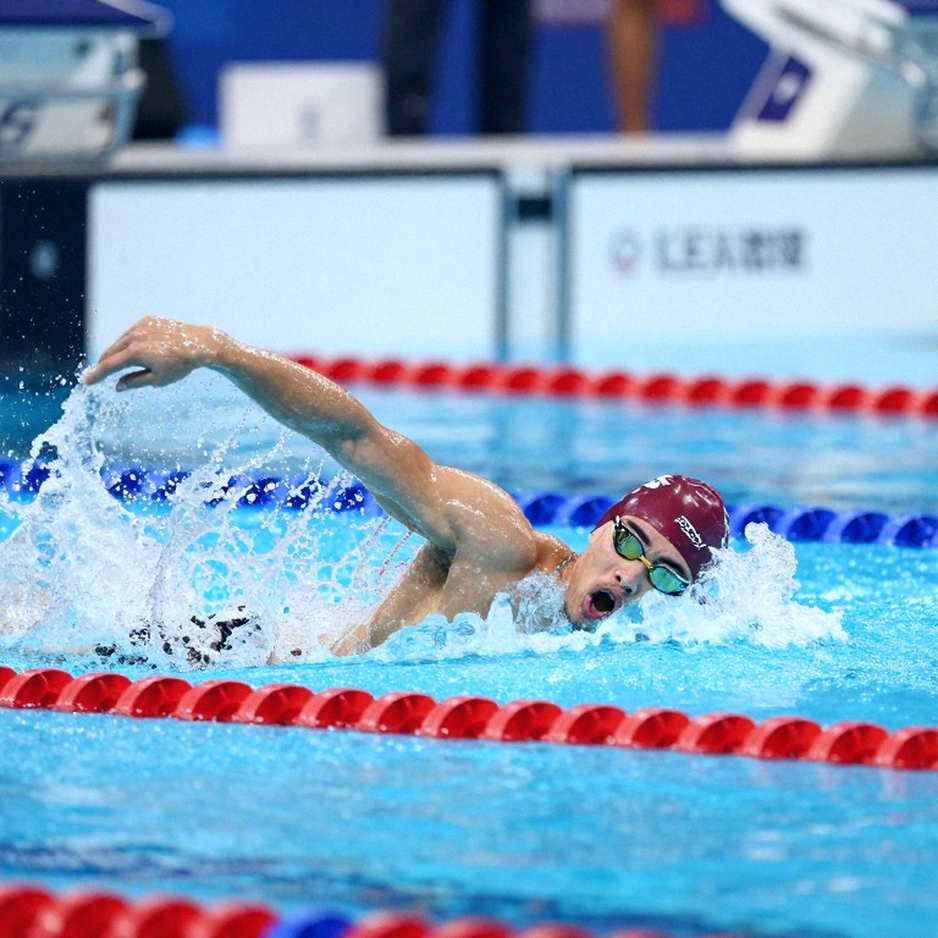
Osaka, an unremarkable April evening on the international swimming calendar, but for the Asian swimming community, it was a historic moment. As the touchpad light flashed, the number 4:05.83 appeared on the electronic scoreboard, Tomoyuki Matsushita had just erased his name from the list of the world's finest swimmers and entered an entirely different class. Not an ordinary victory, not a mere personal best. He had just broken the 4:06 barrier that only four humans on the planet had ever crossed before, and became the first Japanese man to do so. In that moment, the entire grandstand seemed to hold its breath, because they understood they had just witnessed a piece of history written from numbers that were previously only dreamed of.
To understand the magnitude of this achievement, we need to step back a bit. Matsushita, 21, has been a phenomenon in Japanese swimming since his Olympic silver medal in the 400m IM at Tokyo 2026, finishing only behind French superstar Leon Marchand. His 4:08.62 at that Olympics was already a major milestone, but since then, he has continuously improved: 4:06.93 in March of this year, 4:07.21 in September last year, and now 4:05.83. Each time he hits the water, he seems to prove that human limits are merely a relative concept. But what made me, someone who has spent over two decades following swimming, stop and examine closely, was not just the final number, but how he got there.
Before diving into analysis, let's set the context. The 102nd Japanese Intercollegiate Swimming Championships, held in Osaka, is usually a place for young athletes to gain experience and sharpen their skills. But for Matsushita, this was not a casual stroll. He arrived as the 2026 Pan Pacific champion, where he defeated two of America's top swimmers, Carson Foster and Bobby Finke, with a time of 4:06.75. That number had already placed him in the top 9 fastest performers of all time. However, tonight, he not only improved his own time but also broke the Asian record of 4:06.05 held by legendary Kosuke Hagino, a record that had stood since 2026, when Hagino won Olympic gold in Rio. Erasing a legend like Hagino from the record books is not just a victory in time, but a meaningful generational shift.
Now, let me take you into my data analysis room. I have reviewed the race footage, broken down each 50m split, and compared them with Matsushita's previous performances, as well as with Hagino's old record. The first thing I noticed was a clear tactical change. In the butterfly leg (first 50m), Matsushita did not explode out with a ferocious pace. He swam slightly slower than Hagino's old record, but still maintained a favorable position. This shows he has learned to conserve energy for the latter part, a lesson many young swimmers often overlook. In the backstroke leg, he maintained a steady rhythm, not creating a large gap, but not falling behind either. The key point lies in the breaststroke leg, where he began to accelerate, and especially in the final 50m, where he swam at a speed of 56.74 seconds, an astonishing number for an athlete who had already swum 350m. Compared to Hagino's old record, Matsushita swam slower in the first half, but compensated with a phenomenal sprint in the second half. This not only demonstrates superior endurance but also shows maturity in race tactics.
But the data doesn't stop there. Let's look at this 4:05.83 in a historical context. It places Matsushita 4th on the all-time fastest performers list, behind only names like Michael Phelps, Ryan Lochte, and Leon Marchand. What's remarkable is that Matsushita is now the fastest man in the world among those who do not compete in major international meets like the Olympics or World Championships. This means his time was set in a national-level competition, where the psychological pressure is much lower than at an Olympics. Does this diminish the value of the achievement? I don't think so. On the contrary, it shows his potential is even greater when he steps onto the biggest stage. When you can swim that fast in a low-pressure meet, what will you do when facing Marchand at the Olympics?
However, I always remind myself that numbers don't lie, but people always try to lie to numbers. Here, I want to offer a contrarian view. This 4:05.83, impressive as it is, does not automatically make Matsushita the number one contender for the next Olympic gold. Leon Marchand, who holds the world record at 4:02.50, is still in a different league. The gap between 4:05.83 and 4:02.50 is over 3 seconds, a huge margin in swimming. Moreover, Marchand often peaks at major competitions, where the competition is fierce. Matsushita may have closed the gap with the rest of the world, but he still has a mountain named Marchand to conquer. This doesn't mean his achievement is not valuable, but rather that we need to view it soberly. This is a big step forward, but not yet the final destination.
Another blind spot I noticed is the reliance on the final freestyle leg. Matsushita won thanks to an outstanding final 50m, but what if he faces an opponent with similar sprinting ability? In a tight race, where the difference is measured in hundredths of a second, relying too much on one segment can be a double-edged sword. If he doesn't build a big enough advantage in the breaststroke leg, he could be overtaken at the end. This has happened to many other swimmers. I recall the case of Kosuke Hagino, who also had a similar tactic but sometimes failed against opponents with more even pacing. Therefore, Matsushita needs to develop more strength in the butterfly and backstroke legs to gain an advantage early on, rather than just waiting for the end.
But one thing is certain: Matsushita has sent a clear message to the entire swimming world. He is no longer a promising young talent, but a real contender for the crown. By breaking the Asian record, he has asserted his number one status in the continent and is getting closer to the world's leading group. The question is: can he maintain this momentum? Can he improve a few more percentage points to directly compete with Marchand? I believe he can, because I have seen how hard he works, how he analyzes every small detail, and how he is never satisfied with what he has achieved. This reminds me of my own saying: "I once treated models as scripture. Now it's just a compass — but without it, we are lost." Matsushita is using data as a compass to guide his career, and the results are speaking for themselves.
Looking back at the entire race, I can't help but compare it to what I have witnessed in my swimming-watching career. I have seen many records broken, many talents emerge, but rarely have I seen such a dramatic improvement in such a short time. From 4:08.62 at the 2026 Olympics, to 4:06.93 in March, and now 4:05.83, he has improved by nearly 3 seconds in less than two years. This shows a perfect combination of talent, hard work, and a scientific training system. Japan has produced many swimming legends, but Matsushita may be the one to bring them back to a dominant position in the IM, an event they once dominated with Hagino and before him, Kosuke Kitajima.
However, I want to emphasize that this achievement is not just Matsushita's story. It is also the story of the development of Japanese swimming as a whole. When an athlete breaks a barrier, it creates a ripple effect, inspiring the younger generation. I have seen this in Vietnam, where the feats of young swimmers have created a new wave of passion. And I believe that with this achievement, Matsushita will become an icon for young Japanese swimmers, who will look at him and say to themselves: "If he can do it, I can too." This could lead to a new golden generation for Japanese swimming, and that will make opponents wary.
But let's return to the number 4:05.83. It is not just a number; it is a statement. It declares that Matsushita is ready for the biggest challenges. It declares that he is not afraid of any opponent, including Marchand. And it declares that the world record of 4:02.50 is no longer a distant goal, but a reachable target in the near future. Of course, there is still a long way to go, but with this momentum, nothing is impossible. I remember the saying: "xG is not wrong, it's just that football is inherently irrational. After 2026, I learned to count the irrationality." In swimming, there are also irrational elements, but when an athlete continuously breaks limits, we must believe that what he is doing is real, and that it is the result of a serious work process.
Finally, I want to pose a question to all who follow swimming: Are we witnessing the beginning of a new era, where the 4:05 mark will become the standard for top swimmers? Or is this just a momentary burst of a special talent? I lean towards the former. Because when someone like Matsushita breaks a barrier, it opens the door for others. Young swimmers will see that it is possible, and they will strive to achieve the same. This will create a new race, not just between athletes, but between sports nations. And in that race, Japan has a significant advantage with Matsushita leading the way. I will continue to closely follow his career, because I believe we haven't seen the best from this 21-year-old yet. And I will also watch how other swimmers, from the US, from France, from China, will react to this new challenge. World swimming is entering a fascinating phase, and Matsushita is the central figure of that phase.

Cầu thủ liên quan
Bài đề xuất
Marist Hiring Swimming & Diving Assistant Coach: A Signal from the Program Dominating the Metro Conference2026-09-04
Vietnam Swimming Data Analysis: Lack of Information Hinders Development2026-09-06
Jane Kavanagh Commits to Notre Dame: Opportunity for American Women's Swimming2026-09-06
Maria Fernanda Costa Breaks Own South American Record in SCM 200m Freestyle: When Numbers Know How to Hide Things2026-09-05
Asian Record 4:05.83: Matsushita Breaks the 4:06 Barrier, Ushering a New Era for Japanese IM Swimming2026-09-04
Gui Caribe Improves Personal Best in 50m Freestyle to 20.54 Seconds at Jose Finkel Trophy, Leonardo Alcântara Breaks South American Record in 800m2026-09-06
Tomoyuki Matsushita Breaks Asian 400 IM Record: Inside the 56.47 Freestyle Finish2026-09-05
Bài đề xuất
Marist Hiring Swimming & Diving Assistant Coach: A Signal from the Program Dominating the Metro Conference2026-09-04
Asian Record 4:05.83: Matsushita Breaks the 4:06 Barrier, Ushering a New Era for Japanese IM Swimming2026-09-04
Maria Fernanda Costa Lowers Own South American Record In SCM 200 Freestyle2026-09-05
Hugo Gonzalez and the 51.46 Touch: A Spanish Record Is Just the Opening Chapter of an Open Season2026-09-06
The Silent Numbers: Why Vietnamese Swimming Cannot Take Off on the Big Stage?2026-09-04
Jane Kavanagh Commits to Notre Dame: Opportunity for American Women's Swimming2026-09-06
Vietnam Swimming Data Analysis: Lack of Information Hinders Development2026-09-06